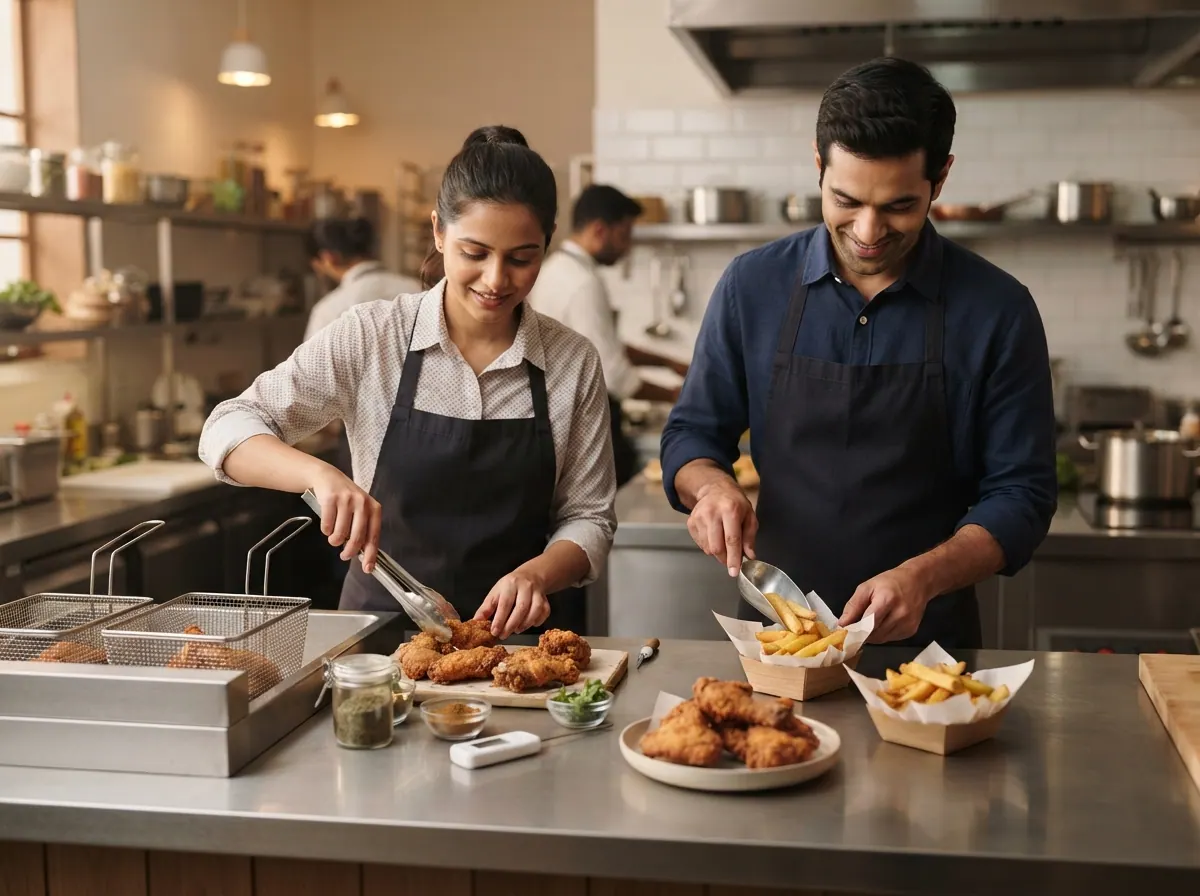
A fried chicken business in India needs a small outlet with a proper kitchen, one or two fryers, a fridge for raw chicken, a tested coating recipe, and about ₹2–10 lakh. A takeaway outlet with a short menu sits near ₹2–4 lakh, while a shop with seating and a fuller menu goes toward ₹10 lakh. The business sells crispy chicken, chips and combos at a good margin on paper, but oil, wastage and rent decide what you keep.
All figures here are estimates. Check prices near you before you spend.
What does it cost?
| Item | Takeaway outlet | Outlet with seating |
|---|---|---|
| Rent deposit and shop fitting | ₹60,000–1.5 lakh | ₹1.5–3 lakh |
| Fryers (open, 1 or 2 tanks) | ₹25,000–60,000 | ₹60,000–1.5 lakh |
| Chiller or fridge for raw chicken | ₹20,000–40,000 | ₹40,000–80,000 |
| Marinating tubs, coating trays, holding cabinet | ₹15,000–35,000 | ₹30,000–60,000 |
| Exhaust hood and duct | ₹15,000–40,000 | ₹40,000–80,000 |
| Counter, signboard, menu | ₹20,000–50,000 | ₹60,000–1.5 lakh |
| Packing: buckets, boxes, sauce cups | ₹10,000–20,000 | ₹15,000–30,000 |
| Licences | ₹5,000–15,000 | ₹10,000–25,000 |
| First stock and working money | ₹40,000–80,000 | ₹1–2 lakh |
| Total | about ₹2.1–5 lakh | about ₹5–10.5 lakh |
Ready-made coating mixes and sauces from suppliers lower the learning curve, but cost more per kilo than your own mix.
What do you sell?
- Bone-in pieces: drumstick and thigh sell well, but take longer to fry and cost more to hold.
- Boneless strips and popcorn chicken: quicker to fry, easier to portion, and loved by students.
- Wings: a good side item.
- Chips (fries): very cheap to make and very high in margin, which is why combos work.
- Burger or wrap with a fried fillet: uses the same chicken and adds a fuller meal.
- Sauces: a good peri-peri or garlic mayo makes the plate memorable.
How much can it earn?
Here is a small takeaway outlet in its third month, selling about 90 orders a day, open 30 days.
Sales
- 50 combo boxes × ₹220 = ₹11,000
- 25 snack boxes (strips or wings) × ₹150 = ₹3,750
- 15 chips and sides × ₹80 = ₹1,200
- Total per day = ₹15,950
- ₹15,950 × 30 days = about ₹4,78,500 a month
Costs each month
- Chicken, flour, spices, chips and sauces: about 40% of sales = ₹1,91,400
- Frying oil: about ₹25,000
- Rent = ₹40,000
- Two staff = ₹30,000
- Gas or power, water = ₹18,000
- Packing = ₹30,000
- Delivery app commission and misc = ₹40,000
- Total = about ₹3,74,400
Left over: ₹4,78,500 − ₹3,74,400 = about ₹1,04,100 before tax and your own pay.
Take care: this is a busy-outlet figure. In the first two months, with 40 orders a day, the same costs for rent and staff could leave you at or near zero. Margin goes first when you give discounts to fill the outlet.
What do you need before you start?
- A recipe tested at home on 20 batches. Crisp coating that stays crisp for 20 minutes in a box is harder than it sounds.
- A chicken supplier with a cold chain. Fresh or properly chilled chicken delivered the same morning.
- Exhaust and fire safety. Hot oil and a closed kitchen make this a place where a fire extinguisher and a proper exhaust are a must.
- A plan for oil. You need a steady supplier, a way to filter, and a rule for when to change.
Step by step
- Pick a short menu: two chicken items, chips, one burger, two sauces.
- Test coating and frying temperature with a thermometer until pieces are cooked through every time.
- Cost every item from the grams of chicken, flour, oil and packing, then price at roughly 2.5 times food cost.
- Take the shop, fit the exhaust, and place raw and cooked areas apart.
- Register with FSSAI and sort out the municipality's trade licence.
- Soft launch for a week with friends and nearby shops, to find slow steps.
- Add delivery apps only after your counter is running smoothly.
Which licences apply?
- FSSAI registration or licence, depending on your yearly sales, on the FoSCoS portal.
- Trade or shop licence from the municipality or panchayat, and shop establishment registration in some states.
- Fire safety. Ask the local fire office what applies to a kitchen with fryers.
- GST once sales pass the limit. Ask a CA.
- Brand names. Do not copy a famous chain's name, logo or look. Pick your own name.
- Rules vary, so confirm each with the local office.
What goes wrong?
- Oil kept too long. It saves money for a week, and the food tastes bitter and burnt. Customers notice quickly.
- Soggy coating in the box. Hot chicken packed tightly steams itself. Use vented boxes.
- Undercooked bone-in pieces. Pink near the bone is a health risk. Check temperature and cooking time every batch.
- Fried too early for the rush. Held chicken goes dry after a short time. Fry in small lots through the hour.
- Chicken price swings. A jump in rates cuts margin if you do not adjust the price list.
- Fire in the kitchen. Grease on the hood and a hot fryer are a danger. Clean the hood regularly and keep an extinguisher near.
Situations you will face
What would you do? Each choice costs something.
Getting started
A pressure fryer gives juicier bone-in pieces but costs far more. Open fryers do strips, wings and chips well.
- Buy a pressure fryer: Costly, juicier bone-in
- Buy two open fryers: Cheaper, drier bone-in
A supplier sells a ready coating mix that works first time. Your own recipe is cheaper per kilo but needs weeks of testing.
- Buy the ready mix: Fast start, higher cost
- Test your own recipe: Waste chicken, unique taste
The fitter quotes for a proper hood and duct. Without it, smoke fills the shop and neighbours will complain.
- Fit the full hood: Costly, cleaner shop
- Fit a smaller hood: Cheaper, weaker pull
One supplier delivers chilled cut pieces daily at a higher rate. A local shop sells fresh birds that you must cut yourself.
- Use the chilled supplier: Higher rate, steady cut size
- Buy and cut yourself: Lower rate, more labour
A friend suggests a name very close to a well-known fried chicken brand. It could bring easy attention.
- Choose your own name: Slower start, no legal risk
- Use a lookalike name: Fast attention, notice risk
The fryer sits near the wall and cardboard boxes. A fire extinguisher and a fixed distance from the wall cost money and space.
- Buy extinguishers and re-place: Cost now, safer kitchen
- Buy one extinguisher only: Cheaper, layout stays
First month
You can open with a big discount to get crowds, or invite a few shops and friends first to find mistakes.
- Big opening discount: Crowd, thin margin
- Invite friends and shops: Slower, fixes mistakes
Customers say the coating is soft by the time delivery arrives. Vented boxes cost more.
- Switch to vented boxes: More per order, crisp food
- Keep current boxes: Cheaper, bad reviews
By day four the oil looks dark and smells a little burnt. A full change is costly.
- Change all the oil: Costly, fresh taste
- Filter and change half: Cheaper, taste still uneven
A customer returns a drumstick that looks pink near the bone. Your new helper fried it for a shorter time.
- Refund, retrain, use a thermometer: Pay and spend time, safer food
- Refund, skip the retraining: Cheap, same mistake may return
A food app offers orders but takes a big share. Your counter is still quiet on weekdays.
- List on one app: More orders, lower margin
- Stay counter and phone only: Keep margin, slower sales
Customers keep asking for peri-peri and garlic mayo. Each sauce costs money and needs a clean storage tub.
- Make two house sauces: Time and cost, better combos
- Offer only ketchup: Cheap, plain plate
Running it
Chicken costs a lot more for three weeks. Your price list was set months ago.
- Raise combo price: Protect margin, fewer orders
- Keep price, shrink pieces: Keeps buyers, quality worry
Chips cost little to make and sell at a high margin. A freezer stock of cut potatoes frees time but costs more.
- Buy frozen chips: Faster, more cost
- Cut potatoes yourself: Cheaper, slower prep
At 7 p.m. orders pile up and each batch takes ten minutes to fry. Customers wait or leave.
- Hire an evening fryer person: Wage, faster batches
- Pre-fry and hold: No cost, drier chicken
A nearby college asks for a student combo at a discount for a month. It brings volume but lower margin.
- Offer the student combo: More volume, tight margin
- Decline politely: Keep margin, lose crowd
Customers want a burger with your fillet. It needs buns, a bun supplier and a bit more prep.
- Add the burger: New item, new prep
- Stay with boxes: Simple, fewer options
The hood filter is thick with grease. Cleaning needs a professional and a day closed.
- Hire a professional cleaner: Cost and a lost evening
- Clean it yourself: Cheaper, may miss spots
Weekday evenings are slow. A wing night with a fixed price could fill the shop, but wings use a lot of chicken.
- Run wing night on Tuesdays: More footfall, thinner margin
- Keep normal menu: Steady margin, slow evenings
A family wants 25 combo boxes delivered at 6 p.m. They ask for a discount.
- Give a small discount: Large order, low margin
- Quote full price: Better margin, may refuse
Power fails for six hours at night. Your raw chicken fridge starts warming.
- Throw the chicken: Big loss, safe food
- Throw it and buy an inverter: Bigger spend, fix for future
When things go wrong
A delivery customer says they felt ill after eating your wings. They post it online.
- Refund, review kitchen steps: Pay now, protect trust
- Delete the comment: Free, trust drops
A pan of oil flares up. Your helper put it out with the extinguisher. The wall is blackened.
- Close two days and repair: Lost sales, safer kitchen
- Close one day, electrician check only: Cheaper, wall repaired later
An officer asks to see your registration, oil records and hand-wash area. Your hand-wash sink is blocked.
- Fix the sink, keep a log: Small cost, safe record
- Show paper only: Cheap, repeat visit risk
A famous fried chicken brand opens a store in the next lane with big offers.
- Run a local-taste combo: Costs a bit, keeps loyal buyers
- Cut prices to match: Keeps crowd, hurts margin
Your main frying cook leaves on a Friday. The coating timings were only in their head.
- Hire a skilled cook, pay more: High wage, quick fix
- Hire a trainee and teach: Cheaper, a week of mistakes
Growing
A shop near a bus stand is available. You would need another cook and fridge.
- Open the second outlet: Big cost, more sales
- Improve the first outlet: Safer, slower growth
A filtering unit extends oil life and keeps taste even. It costs a lot at your size.
- Buy the filter machine: Costly, steadier taste
- Keep manual filtering: Cheap, more oil wasted
A company wants 150 pieces of chicken and chips for an event. It needs a rented warmer and extra staff.
- Take the catering order: Big sale, extra cost
- Decline and focus on shop: Safe, no extra income
Most customers buy the same two combos. A new family bucket could raise bills but needs new packing.
- Launch the family bucket: Higher bill, packing cost
- Keep current combos: Simple, flat bills
Is it right for you?
A fried chicken business suits you if you like fast, repeatable cooking, can handle heat and oil smell, and can stay strict about oil and hygiene. It suits you less if you want a quiet business, because rush hours are loud and hot.
A good test: work a Friday and Saturday evening at a busy fried chicken outlet. If you still like it, open a small takeaway with a short menu, learn your oil cost per day, and add seating only when you are selling out most evenings.