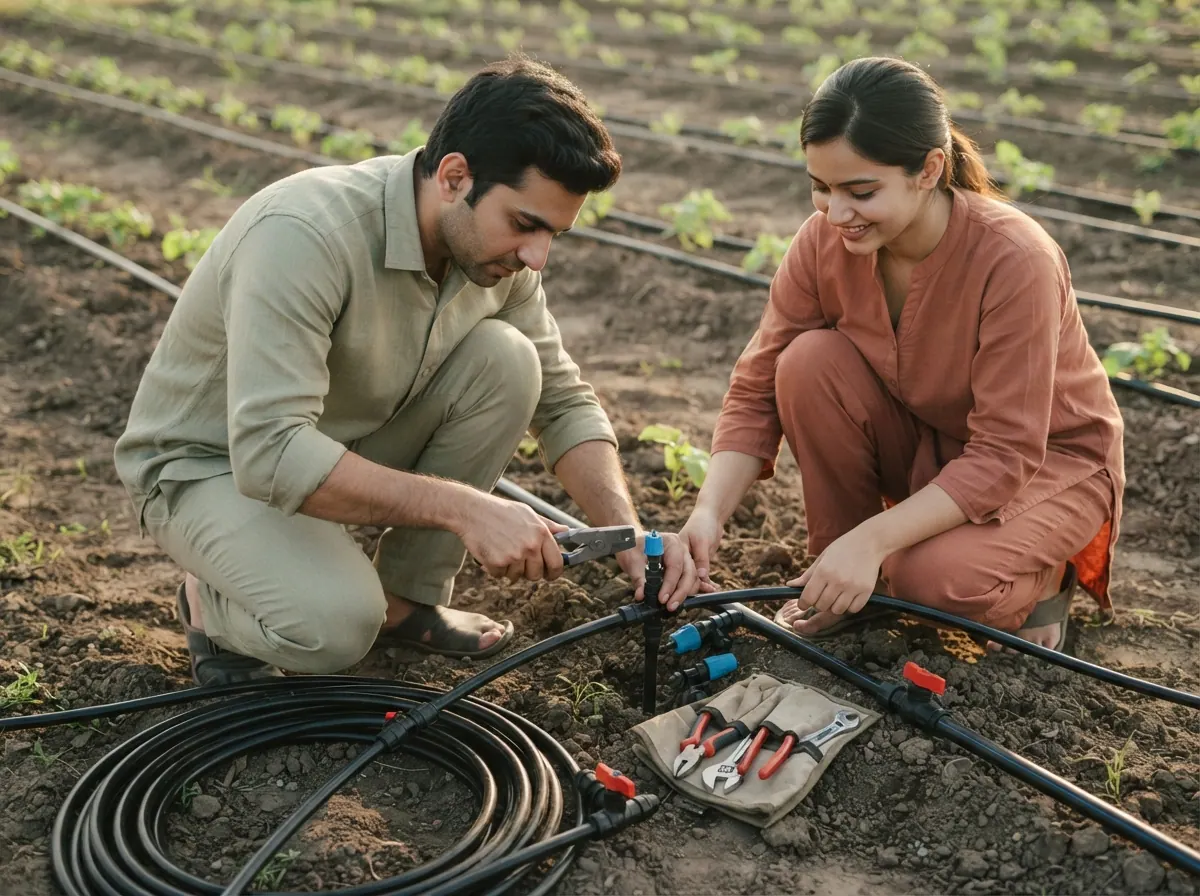
To start a drip irrigation business in India you need a shop or room to stock pipes, drippers and filters, a tie-up with one or two companies, a trained fitter, and about ₹1–5 lakh. You make money by selling the material and by designing and fitting the system on a farmer's field. The work comes in bursts before sowing, so your cash must stretch through the slow months.
All figures here are estimates. Check prices near you before you spend.
What does it cost?
| Item | Small start (about ₹1–2 lakh) | Larger start (about ₹4–5 lakh) |
|---|---|---|
| Starter stock: laterals, drippers, fittings | ₹40,000–80,000 | ₹1.5–2.2 lakh |
| Filters, venturi injectors, valves | ₹15,000–30,000 | ₹50,000–90,000 |
| Tools: pipe cutters, punchers, pressure gauge, measuring tape | ₹10,000–20,000 | ₹25,000–40,000 |
| Two-wheeler or small pickup for site visits | ₹0–50,000 | ₹70,000–1.2 lakh |
| Shop or room advance | ₹10,000–25,000 | ₹30,000–60,000 |
| Working capital for the busy season | ₹20,000–40,000 | ₹60,000–1 lakh |
| Total | about ₹1–2 lakh | about ₹4–5 lakh |
Many dealers get stock on credit from the company or a distributor. That helps cash but makes you dependent on one brand. Check the credit days before you stock up.
What do you actually sell?
- Drip systems: main line, sub-main, lateral pipes with built-in or online drippers, for orchards, vegetables, sugarcane, banana and similar row crops.
- Filters: screen, disc or sand filters, which decide how long the drippers last. Bad water needs a better filter.
- Fertigation: venturi injectors or tanks to push fertiliser through the system.
- Sprinkler sets: for groundnut, vegetables, fodder and other closely sown crops.
- Service: repair, flushing and spare parts, which keep farmers coming back.
How much can it earn?
Take a dealer-installer who completes about 6 acres of drip in a busy month. The rate per acre depends on crop, spacing and filter, so treat these as a guess.
Income
- 6 acres × about ₹45,000 per acre = ₹2,70,000
Costs
- Material at about 70 percent of the price: ₹1,89,000
- Two fitters at ₹12,000 each: ₹24,000
- Fuel and travel: ₹8,000
- Shop rent and phone: ₹7,000
- Total = ₹2,28,000
Left over: ₹2,70,000 − ₹2,28,000 = about ₹42,000 in a busy month.
In the slow months you may do one acre or none, so a year is not twelve of these. Farmers also take time to pay, often until after harvest, so a busy month can leave your cash tied up in receivables. Know how much credit you can carry before you take a big job.
What do you need before you start?
- A company tie-up for products farmers recognise, with terms, spares and technical support.
- A fitter who can design the layout: reading slope, soil, crop spacing and the well's flow and pressure, because a poor design wastes the farmer's water and your name.
- Knowledge of subsidy paperwork from the local agriculture or horticulture office, so you can guide farmers on what to submit.
- Farmer contacts. Visit farms, farmer groups and fertiliser shops.
Step by step
- Visit your agriculture or horticulture office and ask which companies are approved and how the subsidy process works now.
- Choose one or two companies, compare dealer terms, and ask for training for your fitter.
- Set up a small shop with a demo plot or sample board, because farmers like to see a working dripper.
- Offer a free survey of the field, with a drawing and a written quote.
- Install the system with the farmer present, test pressure at the far end, and show them how to flush the lines.
- Take a written handover with the date, material list and your phone number.
- Visit after the first month to check clogging, leaks and water pressure.
Which licences apply?
- Shop or trade registration with your local body.
- GST registration if your turnover needs it. Ask a CA.
- Dealership agreement with the company whose products you sell.
- Subsidy schemes. Central and state micro-irrigation schemes, such as the one that supports water saving on farms, have helped farmers pay for drip and sprinklers. Only your district agriculture or horticulture office can say what is open now and what documents are needed.
- Loans. A bank may give a dealer loan, and farmers sometimes finance a system through crop or agri loans. Confirm with the bank.
What goes wrong?
- Promising subsidy you cannot be sure of. If the money is delayed or refused, the farmer blames you.
- Choked drippers from bad filters. Hard or muddy water blocks drippers within a season. The cheap filter often costs the farmer much more later.
- No flushing. Farmers who do not flush the lines see uneven growth and blame the system.
- Wrong design. Too many laterals for the well's flow means the last plants get no water.
- Rats, cattle and tractors. Laterals get chewed or cut. Tell the farmer where to protect the pipes.
- Stuck credit. A farmer pays after harvest, and the company asks you for money earlier.
Situations you will face
What would you do? Each choice costs something.
Getting started
A big brand gives small margin but farmers know it. A local maker gives better margin and less support.
- Take the known brand: Lower margin, easier sales
- Take the local maker: Better margin, less trust
The company offers a big starter lot at a discount, with 30 days credit.
- Take the big lot: Credit helps, pressure later
- Take a small lot: Less risk, may run out
A farmer near the road offers a corner of their field if you lay a small drip set free.
- Lay the demo set: Cost now, farmers see it work
- Show photos only: No cost, farmers doubt
A trained fitter wants ₹14,000. A local boy will learn for ₹8,000.
- Hire the trained fitter: Costly, fewer mistakes
- Train the local boy: Cheaper, slower first jobs
A farmer wants you to run their subsidy file and says they will pay only after it clears.
- Help them with the file: Time spent, may win them
- Tell them to go alone: No time lost, farmer cold
Competitors charge for a survey. Doing it free wins trust but costs half a day.
- Offer free surveys: Costs time, wins orders
- Charge for the survey: Pays your time, fewer calls
A shop near the fertiliser lane costs ₹6,000 more per month. One outside is cheaper.
- Rent near the fertiliser lane: Costly rent, farmers pass by
- Take the cheaper outer shop: Low rent, fewer visitors
First month
A farmer holds your quote of ₹45,000 an acre and a rival's for ₹38,000.
- Explain the better filter: Lose some, trust your quality
- Match the lower quote: Wins job, thin margin
After fitting, the last rows get a trickle. The well pump is weak.
- Redo the layout in two zones: Costs a day, system works
- Suggest a bigger pump: Cheaper now, they may blame you
A good farmer wants a ₹60,000 system and will pay after harvest in five months.
- Give them credit: Wins job, cash tied up
- Ask half in advance: Safer, they may go elsewhere
A farmer's borewell water looks clear but leaves white scale on the pump. A lab test costs money.
- Pay for a water test: Small cost, right filter
- Skip the test: Saves cost, filter may fail
Running it
Ten farmers want drip fitted before sowing. You have only two fitters.
- Hire two helpers for the week: Meets orders, extra cost
- Take only six jobs: Better quality, lose some
A farmer calls: rats and a cow have damaged their new laterals.
- Repair free once: Cost to you, loyal customer
- Charge for repair: Fair, they may be unhappy
Muddy canal water has choked drippers on one farm. Their filter was the cheap one.
- Sell them a filter at cost: Small loss, trust returns
- Say it is their problem: No cost, they tell others
A farmer group wants sprinkler sets for 12 acres at a discount.
- Give a group discount: More volume, lower margin
- Keep full rates: Higher margin, may lose it
Your distributor wants the last lot's ₹70,000 now while farmers owe you for months.
- Pay from your own cash: Cash tight, supply safe
- Ask for two more weeks: Keeps cash, strains the link
Banana growers want to feed fertiliser through the lines.
- Stock injectors and tanks: Costs now, new income
- Send them elsewhere: No cost, lose orders
A 15-acre orchard is 60 km away. The trip costs a day each way.
- Take the job: Large order, travel cost
- Decline: Skip effort, lose money
When things go wrong
A lot of laterals cracks after weeks of heat. Three farmers call.
- Replace all at your cost: Heavy cost, strong trust
- Replace only two farmers' pipe: Cheaper, others unhappy
A farmer's subsidy is delayed by months and they refuse to pay the balance.
- Wait and keep in touch: Keeps trust, cash stuck
- Offer a part-payment plan: Slow money, keeps trust
Two months pass with only repairs. Shop rent and wages continue.
- Offer service visits: Small income, goodwill
- Cut staff for two months: Saves cost, may not return
A rival sells look-alike pipe at half the price and says it is the same.
- Show farmers the difference: Slow, builds trust
- Stock cheap pipe too: More sales, quality risk
The company sends 4 litre drippers instead of 2. Planting day is tomorrow.
- Delay and exchange: Lose a day, correct system
- Fit them and explain: On time, wrong flow
A farmer claims their water bill rose after drip was fitted. Your design was right.
- Visit and teach scheduling: Costs a day, wins them
- Say the system is fine: No time, loses trust
Growing
Another company offers its agency and a second range of products.
- Take the second agency: More range, more stock
- Stay with one: Focus, less choice
Your two-wheeler cannot carry big rolls. A used pickup costs a lot.
- Buy a used pickup: Costly, faster jobs
- Hire a pickup per job: Lower cost, delays
A group of orchard owners wants 40 acres in a season, with payment in parts.
- Take the contract: Large income, long credit
- Take 20 acres: Lower risk, steady growth
Farmers who already own drip need flushing and repair each season.
- Start a yearly service plan: Steady income, fitter time
- Repair only when called: No planning, uneven income
A taluka 40 km away has many orchards but no dealer.
- Open a small branch: Costly, wider reach
- Visit weekly from here: Low cost, less presence
A fertiliser shop offers to host a demo day with 50 farmers.
- Run the demo day: Costs snacks, many leads
- Skip it: No cost, miss leads
Is it right for you?
Drip irrigation suits you if you are comfortable in a field, can explain water, soil and fertiliser in plain words, and can wait for payments. It suits you less if you want a steady daily income, because the season decides how busy you are.
A good test: work with a local dealer for one planting season. Watch how they survey a field, how they handle a farmer's complaint, and how long the money takes to arrive. Then decide if you want to carry that risk.