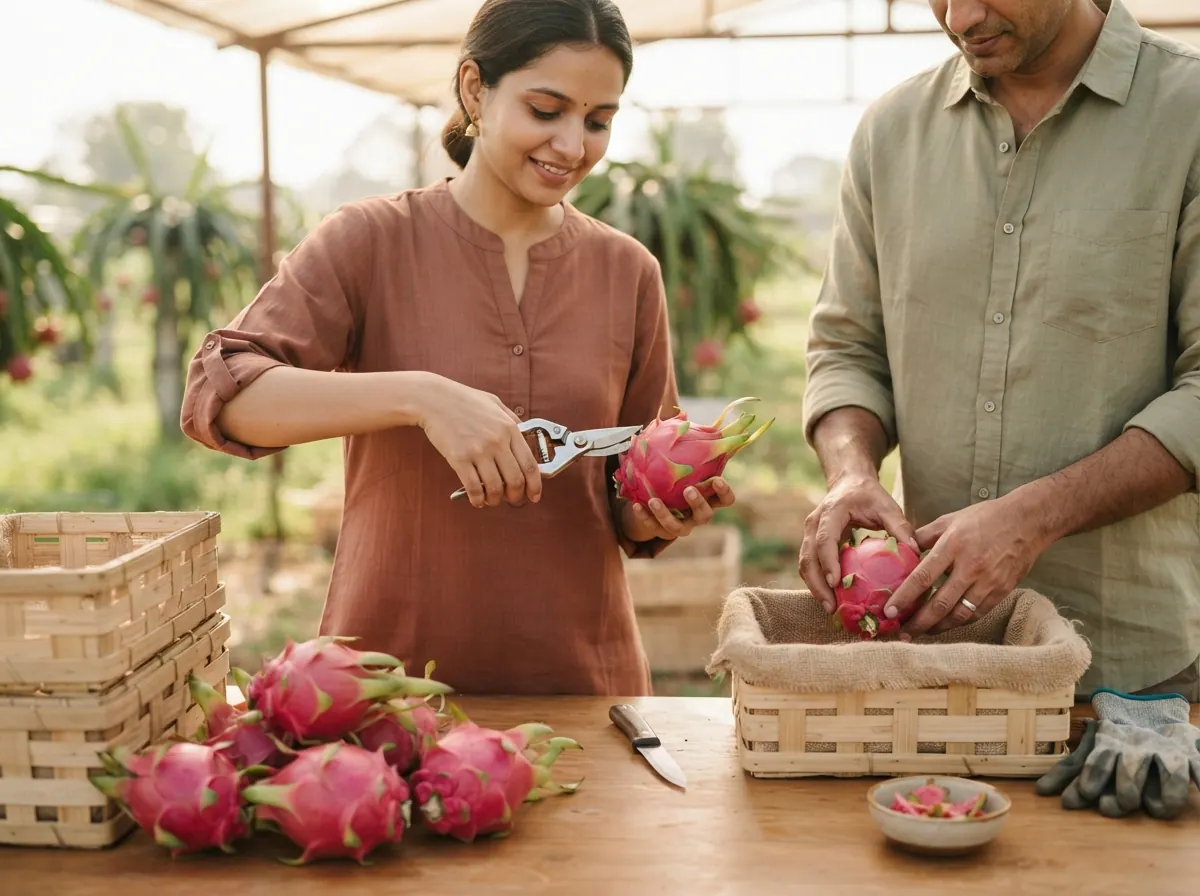
Dragon fruit farming in India costs about ₹4–8 lakh for the first acre, mostly for concrete poles, plants, drip and a fence, and the first full crop comes in the third or fourth year. The plant is a climbing cactus that needs little water but a strong support, and the money comes late: you pay up front for poles and wait for years before the fruit pays back.
All figures here are estimates. Check prices near you before you spend.
What does it cost?
One acre, about 500 poles with four plants on each pole:
| Item | One acre |
|---|---|
| Land preparation, pits, manure | ₹30,000–50,000 |
| Concrete poles (about 500 × ₹450–600) | ₹2.25–3 lakh |
| Plants (about 2,000 × ₹30–60) | ₹60,000–1.2 lakh |
| Top rings or frames for the poles | ₹25,000–50,000 |
| Drip system | ₹35,000–60,000 |
| Fencing | ₹30,000–70,000 |
| Fertiliser and labour in year one | ₹40,000–80,000 |
| Pruning tools, crates | ₹10,000–20,000 |
| Total | about ₹4.5–8 lakh |
Some farmers use cheaper supports like treated wood or old pipes, but they rot or bend. Ask a farmer who has been through three monsoons.
The poles must carry a heavy plant for twenty years or more, so check the quality. A weak pole bends in the first storm.
What do you plant?
- White-fleshed (red-skinned) varieties: the most common, and often easier to sell and grow.
- Red-fleshed varieties: command higher prices in some markets, but a few are harder to grow and some do not set fruit well alone. Ask the nursery and a working farm.
- Yellow types: rarer, with a niche market.
Check what your nearest buyer wants before you buy plants. Cuttings from a trusted nursery should be named by variety and, if possible, from a mother plant that has actually fruited.
How much can it earn?
Here is one mature acre in about its fourth year, with good care and a buyer.
Income
- Yield: about 6,000 kg an acre (a young orchard gives much less)
- Average price: about ₹70 a kg (it can be lower in a glut and higher in a good market)
- 6,000 × ₹70 = ₹4,20,000
Costs a year
- Manure and fertiliser = ₹60,000
- Pruning, tying and general labour = ₹50,000
- Harvest labour = ₹30,000
- Water and power = ₹15,000
- Sprays = ₹15,000
- Crates, packing and transport: 6,000 kg × ₹3 = ₹18,000
- Total = ₹1,88,000
Left over: ₹4,20,000 − ₹1,88,000 = ₹2,32,000 a year, or about ₹19,300 a month. This is before any loan payment and before the first years of little income. At ₹5 lakh set-up, a payback of three to four years of mature income is realistic, if prices hold. If the market price falls to ₹40, the same crop earns ₹2,40,000 and you keep only ₹52,000.
Dragon fruit flowers at night from about May to October in many areas, with several flushes of fruit. Buyers want fruit that is uniform and unblemished.
What do you need before you start?
- Well-drained land. Standing water rots the base of the plants. Choose a slope or raise the beds.
- Money for three years. Poles and plants are paid for at once, and sales are small in the first two years.
- A buyer. Visit a fruit mandi or a supplier of premium fruit before you plant. Many new farmers find that supply arrives faster than demand in their area.
- Strong poles and good cuttings. These two decisions decide the next twenty years.
- Light. The plants need full sun, and some farmers add lights to extend flowering. Ask a working farm what it costs.
Step by step
- Visit three dragon fruit farms, including one that is over four years old. Ask what it earned in the best and the worst year.
- Check your soil and water, and ask the horticulture office about suitable varieties for your area.
- Set the poles in pits with good concrete bases, and use rings or frames at the top.
- Plant the cuttings around each pole and tie them loosely. Protect young plants from strong sun and from wet feet.
- Fit drip and mulch to keep moisture even and weeds low.
- Train and prune every year. A well-trained plant gives more fruit than a tangled one.
- Line up buyers early. Ask for a rate before the first harvest, and sell small lots to test the market.
Which licences apply?
Dragon fruit needs little paperwork, but check these:
- Land and water. A borewell or electric connection may need permission. Ask the local office.
- Subsidy and loans. Horticulture missions and state schemes have supported dragon fruit planting, and banks lend for orchards. Rules and amounts change, so ask your district horticulture office before you buy.
- Pesticides. Buy from a licensed dealer and follow the waiting period.
- Selling value-added items such as jam, juice or dried fruit needs a food licence. Ask the licensing office.
- Tax. Ask a CA how your income and any subsidy are treated.
What goes wrong?
- Everyone plants because it is fashionable. When supply reaches your local market, the price can fall hard.
- Rot in the monsoon. Waterlogged plants and fungus eat the base and stems.
- Weak poles or cheap cuttings. Bent poles and wrong varieties cost years.
- Little fruit in the first years. A farmer who borrowed heavily may not last.
- Damaged skin and sunburn. Buyers pay less for marked fruit.
- Birds, ants and fruit flies. Ripe fruit attracts them and loss builds up.
Situations you will face
What would you do? Each choice costs something.
Getting started
A local maker sells concrete poles at a lower rate. Some show thin steel and hairline cracks.
- Buy tested strong poles: Costly, last for decades
- Take the cheaper poles: Saves money, bend risk
A nursery sells cuttings cheaper, but cannot name the mother plant. Another asks more with records.
- Pay for named cuttings: Higher cost, known variety
- Buy the cheap cuttings: Saves money, variety unknown
Red-fleshed fruit fetches more in some markets. White-fleshed plants are hardier and easier to grow.
- Plant the red variety: Higher price, harder to grow
- Plant the white variety: Easier, lower price
Part of your field floods in heavy rain. Raising the beds costs money.
- Raise and drain the beds: Costly, plants stay dry
- Plant as it is: No cost, rot risk
A city fruit dealer says they will see you if you travel. It means a day away and your own bus fare.
- Go and ask the terms: Small cost, clear rate
- Plant first, ask later: No trip, no buyer yet
The plants need little water. Drip costs money but gives steady, light moisture.
- Fit the drip: Costly, even moisture
- Water by hand: Cheap, tiring, uneven
Animals are damaging young plants at night. A fence is a big bill for a small field.
- Build a strong fence: Costly, plants safe
- Hire a night watchman: Monthly cost, some loss
First month
After a hot spell the new cuttings look scorched. Shade nets cost money.
- Put up shade nets: Costly, plants recover
- Wait for cooler days: Free, some will die
A few plants show soft, rotting bases after rain. Fungus spreads quickly in wet weather.
- Cut and treat them: Labour, saves the rest
- Leave them alone: Free, rot spreads
Ants are eating tender shoots and nesting at the pole base. Treatment costs money.
- Treat the poles and soil: Costs now, shoots grow
- Ignore them: Free, damaged shoots
Shoots must be tied loosely to the pole. Your worker says it takes too long.
- Hire a trained worker: Costs more, even growth
- Let shoots grow free: Free, tangled plants
Weeds are climbing around the pole bases. A weedicide can burn the young stems.
- Weed by hand: Labour, safe stems
- Use a weedicide: Cheap, burn risk
Running it
A farm nearby uses lights to get fruit later in the year. It means wiring, power and some risk.
- Install lights on part: Cost, off-season fruit
- Stay with natural season: No spend, glut risk
Your first harvest has small, medium and large fruit. A buyer wants only the large ones.
- Grade and sell by size: Labour, better rate
- Sell all in one lot: Easy, lower rate
After a dry spell followed by heavy rain, ripe fruit is splitting. Buyers reject cracked ones.
- Steady watering and picking early: Labour, fewer splits
- Pick as it ripens: No change, losses
Birds visit at dawn and mark the best fruit. Nets are costly for a full acre.
- Net the fruiting rows: Costly, cleaner fruit
- Use scare ribbons: Cheap, still losses
A city hotel wants fruit each week at a fixed rate, with set size and no marks.
- Sign the weekly supply: Steady money, strict grading
- Sell in the mandi: Higher highs, big swings
Cushioned boxes protect the fruit on the long trip. They cost much more per kilo than open crates.
- Use cushioned boxes: Costly, fewer bruises
- Use open crates: Cheap, bruised fruit
Your plants are lush but flowering less than a nearby farm's. Your plants may be over-fed with nitrogen.
- Change the feeding plan: Advice fee, fewer flowers now
- Feed more to push growth: Costs more, leafy plants
After harvest the tangled stems need cutting back. Heavy pruning cuts next year's flowers if done wrongly.
- Hire a trained pruner: Costly, better next crop
- Prune with your own staff: Cheap, uneven cuts
When things go wrong
Many new orchards are fruiting in your district. The mandi rate drops.
- Sell direct to city shops: More work, better price
- Sell at the low rate: Poor money, quick sale
Strong wind bent poles under heavy plants. Fixing them means lifting plants and resetting the base.
- Reset with strong poles: Costly, safe afterwards
- Prop with bamboo: Cheap, may fail again
It is year two. Your loan instalment comes up but the first fruit has not sold yet.
- Ask the bank for time: Interest rises, cash saved
- Pay from family money: Costs savings, stays clean
A dealer took your whole lot and pays half now and half after selling it.
- Cash only next time: Safer money, fewer sales
- Keep selling on credit: More owed, sales continue
Dark spots are spreading along stems in the humid weeks. A spray plan costs money.
- Follow a proper spray plan: Costly, protects fruit
- Spray only once: Cheap, disease returns
Growing
Your first acre is selling steadily. A second acre means another large bill for poles and plants.
- Plant the second acre: Big spend, more fruit later
- Perfect the first acre: Small spend, steadier fruit
Beginners want cuttings from your fruiting plants. Selling them means trimming and a bit of care.
- Sell named cuttings: Extra income, more competition
- Keep your edge: No income, fewer rivals
Misshapen fruit sells low. A small unit could make jam or dried chips, but needs a food licence.
- Set up with a licence: Cost, steadier income
- Sell seconds cheaply: No licence, low income
The district horticulture office mentions support for dragon fruit planting. It needs papers and nothing is promised.
- Apply with a CA's help: Fees, cleaner records
- Skip the paperwork: No fees, no support
New growers ask to tour your orchard and learn. It takes your time and may bring both customers and rivals.
- Hold paid farm visits: Time spent, some income
- Keep the farm closed: Saves time, no goodwill
Is it right for you?
Dragon fruit suits you if you have well-drained land, can live for years on other income while the orchard grows, and have a reliable way to reach buyers. It suits you less if you plan to repay a large loan from the first crop.
A good test: before spending lakhs, visit a farmer whose plants are four years old, and ask them to show their sales book. Then start with a small plot and prove that the fruit sells before you plant the whole acre.