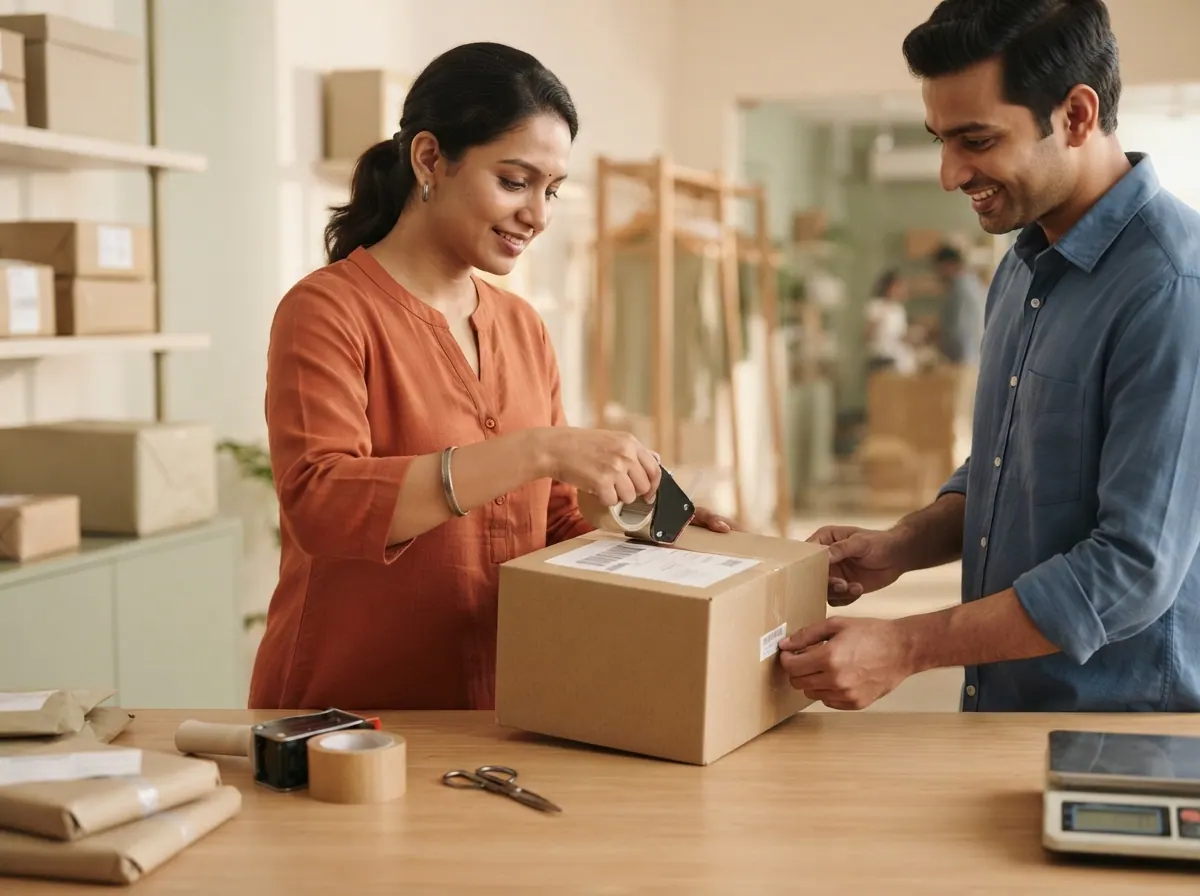
A courier franchise or parcel point is a small shop that books parcels for a courier company, hands over incoming parcels and sometimes runs local pickups and deliveries. It can start from about ₹1 lakh to ₹5 lakh, depending on shop deposit, fittings, a computer with printer, weighing scale and any security deposit the company asks for. You do not set the price. You earn a commission on each parcel, so it is a business of volume, discipline and small margins.
All figures here are estimates. Check prices near you and get commission terms in writing before you spend.
What does it cost?
| Item | Estimate |
|---|---|
| Shop rent deposit (small shop, 1–3 months) | ₹20,000–80,000 |
| Counter, shelves, signboard, branding | ₹20,000–70,000 |
| Computer, label printer, barcode scanner | ₹25,000–60,000 |
| Digital weighing scale | ₹3,000–8,000 |
| Packing stock: tape, cartons, bubble wrap, covers | ₹10,000–25,000 |
| Rider's bike (if you do deliveries) | ₹0–70,000 |
| Franchise or security deposit (varies by company) | ₹0–1,50,000 |
| Working reserve for two months | ₹40,000–80,000 |
| Total | about ₹1.2–5.4 lakh |
You can keep the bottom of this range if you take a delivery-only agency, use your own bike and run it from a small shop. Companies differ widely. Some charge a fee, others ask for a deposit, others set targets. Compare two or three before you decide.
How much can it earn?
Assume a small booking counter that also does local pickups and deliveries. The commission numbers below are assumptions to show the arithmetic. Your company's slab will differ.
- Booking commission about ₹22.5 per parcel accepted (a share of the booking charge)
- Delivery commission about ₹10 per parcel delivered
A good month
- Bookings: 40 a day × ₹22.5 × 26 days = ₹23,400
- Deliveries: 80 a day × ₹10 × 26 = ₹20,800
- Total income: ₹44,200
- Rent ₹8,000 + rider ₹14,000 + fuel ₹4,500 + internet, power and packing ₹3,500 + small costs ₹1,000 = ₹31,000
- Left over: ₹44,200 − ₹31,000 = ₹13,200
A slow month
- Bookings: 25 a day × ₹22.5 × 26 = ₹14,625
- Deliveries: 50 a day × ₹10 × 26 = ₹13,000
- Total income: ₹27,625
- Costs stay near ₹31,000
- Left over: about −₹3,400
That is a small business, and you see why. If you ride the deliveries yourself and skip the rider, you add ₹14,000 a month. Bookings from small online sellers and regular shops are what lift income, because one seller sending 15 parcels a day is worth more than fifteen walk-ins. Festival months, such as the weeks before a big festival, push volume up sharply. Then the weeks after drop.
What do you need before you start?
- A list of senders, not just a shop. Visit online sellers, home bakers, boutiques, pickle and sweet makers and small traders within a few kilometres. Ask how many parcels they send and how they pay.
- A company with real delivery in your area. Ask which pin codes are served and how long deliveries take. Slow delivery brings complaints to your counter, not to the company's head office.
- A rider you trust, as parcels and cash pass through their hands.
- A shop near a market, college or housing area, easy to stop at.
Step by step
- Talk to two or three courier companies and ask for written terms: commission slab, deposit, targets, who pays for lost or damaged parcels, and how often you are paid.
- Check the company's coverage for the pin codes your customers send to most. An agency that cannot deliver to your top five destinations will lose customers.
- Rent a small shop with room for a counter, a rack and a place to pack.
- Set up the software and printer, and train yourself on booking, tracking and cash-on-delivery handling.
- Visit local sellers with a rate card and offer pickup at a fixed time every day.
- Fix your packing charges for small items, and charge them clearly. Keep a few good cartons and a lot of tape.
- Keep every receipt and a daily cash book, separating the company's money from yours.
- Add other services slowly, such as photocopy, lamination or passport photo, only if they fit the same counter.
Which licences and papers apply?
- Shop and establishment registration or a local trade licence. Ask the municipal office.
- GST, if your turnover or the company's terms require it. A CA can explain your case.
- KYC and agreement with the company, often with shop proof, ID, address and a signed agreement.
- Prohibited items rules. Companies list items they will not carry, and you are responsible for checking at the counter. Ask for the list in writing.
- Cash handling. If you collect cash on delivery, keep a clear record and deposit it to the company on its schedule.
What goes wrong?
- Lost or damaged parcels. The customer comes to you, not to the head office. Ask the company in advance how claims work and what you must pay.
- Cash-on-delivery money held up. If the company pays you late, you may run short while the rider keeps collecting.
- Delivery delays in festival weeks. A parcel stuck for two weeks makes your counter the face of the delay.
- Customers who pack badly. A cheap carton and one layer of tape comes back as "damaged". Check at the counter, not later.
- Banned items. A seller who hides a restricted item gets you in trouble with the company.
- Targets and shifting terms. Companies can change commission or add targets. Read the agreement and ask what happens if you cannot meet them.
- Rider keeps parcels or cash. A scan at every handover and an evening cash check makes this rare.
Situations you will face
What would you do? Each choice costs something.
Getting started
One company has a big network but asks for a deposit and targets. A smaller one has easy terms and weaker delivery to far cities.
- Join the big network: Deposit and targets, wide reach
- Join the smaller company: Easy terms, limited reach
The company wants your signature today. A friend who is a CA offers to read it, but the offer ends tonight.
- Get the CA to read it first: Costs a day and a fee
- Sign today: Start sooner, hidden terms
A shop at the market corner costs twice the rent. A quieter lane is cheap but near few sellers.
- Take the market corner: High rent, walk-in customers
- Take the quiet lane: Low rent, you must find senders
The company offers a one-day training, and your first few bookings are slow and full of errors.
- Attend the full training: Lose a shop day, fewer errors
- Learn by doing: Keep the shop open, mistakes
Local deliveries pay per parcel and need a bike. A second-hand bike costs money, or you could use your own.
- Buy a bike for the rider: Spend now, steady deliveries
- Use your own bike: No spend, you are on the road
Customers expect cartons, tape and bubble wrap at the counter. Buying in bulk saves money but blocks cash.
- Buy in bulk: Lower rate, cash locked up
- Buy small lots weekly: Higher rate, cash flexible
A group of six home sellers wants a 5 pm pickup every day. It adds a trip for your rider but brings steady parcels.
- Offer daily pickup: More parcels, extra fuel cost
- Ask them to drop at the counter: No trip, fewer parcels
First month
A seller brings a glass item in a thin cover and wants it sent quickly. A proper pack costs time and money.
- Repack it properly, add a fee: Slower, protects the parcel
- Send it with a damage note: Customer signs, risk shared
A regular seller's box feels like it has something the company does not carry. They say it is only a gift.
- Ask them to open the box: Awkward, you stay safe
- Refuse the parcel in writing: Lose this parcel, stay legal
The tracking is stuck for ten days. The customer wants their money back now, and the company's claim takes weeks.
- Refund them, claim later: Costs you now, trust kept
- Tell them to wait for the claim: Safe cash, unhappy customer
The company has delayed your cash-on-delivery payout by a week. Your rider and rent are due.
- Pay from your savings: Cash drained, team paid
- Ask the rider to wait: Cash safe, rider upset
The COD cash they handed over is less than the slips show. They say they lost a note.
- Deduct from their pay: Recover money, strains trust
- Start a daily slip check: Effort, honest handovers
A seller sending 15 parcels a day wants a lower rate or they will go to another counter. The rate is partly set by the company.
- Share part of your commission: Keep them, lower margin
- Refuse a discount: Full margin, they may leave
Running it
Volume doubled before the festival. Your rider cannot manage all deliveries, and customers are calling every hour.
- Hire a temporary rider: Extra cost, deliveries on time
- Let deliveries run late: Save money, angry calls
The slip shows delivered, with a signature. The customer says it was not them, and the neighbour agrees.
- Check the rider's route and photo: Time spent, truth found
- Tell them it is delivered: Quick, they complain to the company
A new online seller keeps booking COD parcels that return. Each return costs your rider time and the company charges back.
- Ask for prepaid or verified COD: Fewer parcels, fewer returns
- Accept all of them: More volume, return losses
A rival offers a free pickup and a loyalty card. Two small sellers have asked what you can offer.
- Match with free pickups: Fuel cost, keeps sellers
- Hold, stress your service: Better margin, lose some
People coming for courier ask for photocopies and lamination. A copier is costly and takes counter space.
- Buy a copier: Extra income, more work
- Stay with courier only: Simple counter, no extras
The company wants 25 percent more parcels or the commission slab drops. Your area has not grown.
- Push sellers with offers: Cost of offers, target maybe met
- Accept the lower slab: No effort, lower income
Roads are flooded for three days and parcels pile up at your counter. Customers call and the rider cannot go out.
- Message each customer: Takes time, trust kept
- Wait for the weather: No effort, many complaints
Many COD parcels came back undelivered and sit on your shelf. Senders are calling to ask what to do.
- Call each sender, resend: Time spent, fewer losses
- Return them in one lot: No effort, senders upset
When things go wrong
A customer picked up the wrong parcel when you stepped out. It contains something costly, and its owner is furious.
- Pay for the loss: Heavy cost, reputation held
- Check the camera, then decide: Time spent, find the truth
The company deducted money for lost parcels and says you did not follow the process. You think the loss was theirs.
- Ask for a written breakup: Effort, may get some back
- Accept the deduction: Keeps relations, you lose money
Your rider left for a better job with deliveries piled up. A replacement asks for double daily pay.
- Pay the high daily rate: Costly, deliveries move
- Deliver yourself, shut counter: Free, bookings lost
Your commission payment has not come. Rent is due, and the company says the finance team is slow.
- Borrow to cover rent: Interest cost, shop stays open
- Delay the rent: No cost, landlord warns you
Your volume has been below target for three months. They offer to continue if you take extra stock and branding.
- Accept and invest: Costs money, keeps franchise
- Switch to another company: Fresh start, lose network
Growing
A friend offers a small counter near a college. Students send and receive many parcels, but you need a second helper.
- Open the second point: Rent and helper, more volume
- Improve this counter: Smaller spend, slower growth
A small manufacturer wants daily pickup of 30 parcels at a discounted commission, with payment monthly.
- Sign the monthly deal: Steady volume, lower margin
- Keep retail customers: Better margin, uneven volume
Shops nearby want same-day delivery inside the town. You could add riders and a simple booking number.
- Add local same-day delivery: Riders and fuel, new income
- Stay with the company work: Simple, no extra risk
You could invite 20 local online sellers for a morning with chai, rate cards and a sample pack, to win steady senders.
- Hold the meet: Cost of snacks and time
- Visit sellers one by one: Free, slow
Is it right for you?
This suits someone who is patient with customers, good with small cash and records, and happy to build a base of senders in one neighbourhood. It works best when you already know local sellers.
It suits you less if you want quick profit, dislike dealing with complaints about other people's delivery, or cannot be present at the counter. Before you sign, ask the company for the commission slab on paper and the name of one existing franchisee nearby. Call that person and ask what they earn in a slow month.