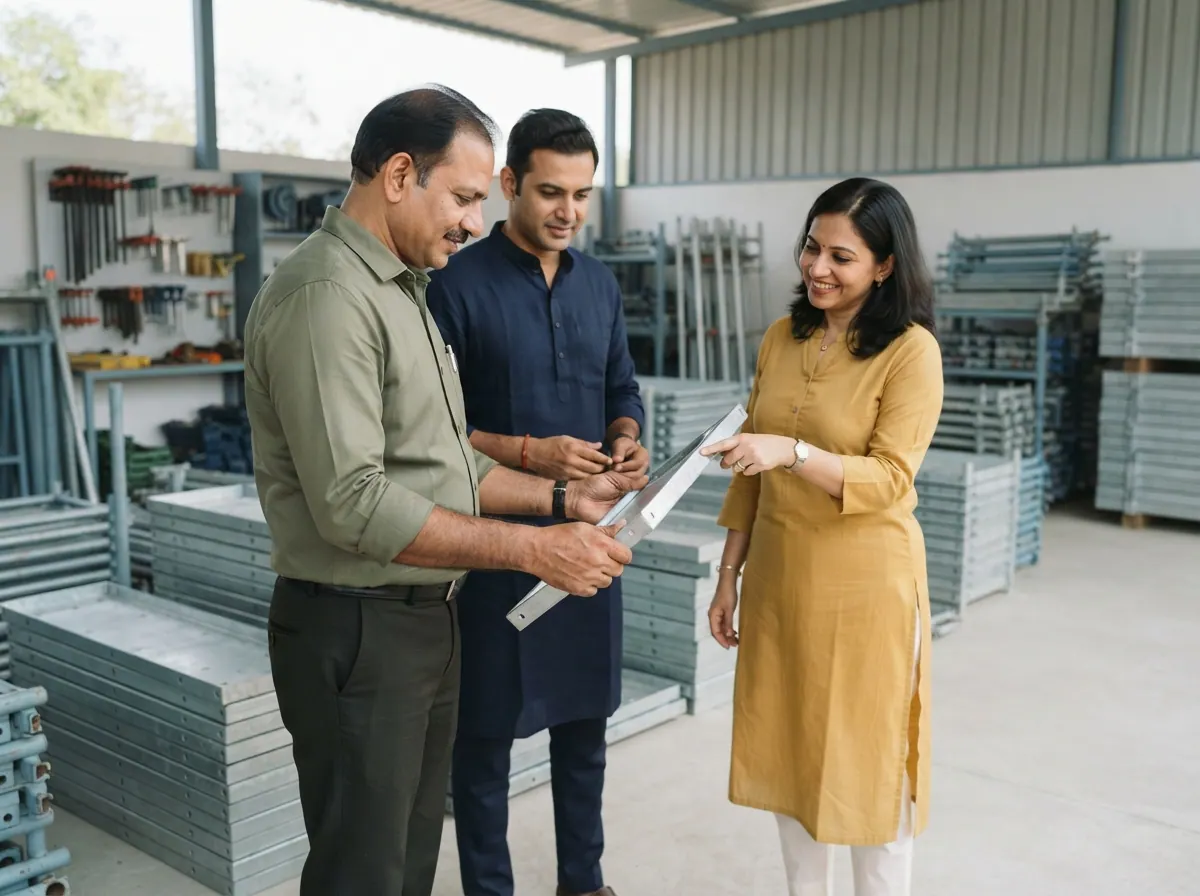
To start a centering plate rental business in India you need steel plates and props, a yard to store them, a small vehicle to carry them, and about ₹3–10 lakh. You rent the same material to builders again and again. So the question is not how many plates you own but how many days each plate is out on a site.
All figures here are estimates. Check prices near you before you spend.
What does it cost?
| Item | Small start (about ₹3–4 lakh) | Bigger start (about ₹8–10 lakh) |
|---|---|---|
| Steel centering plates | 500–700 plates, ₹2–2.8 lakh | 1,500–1,800 plates, ₹5.5–7 lakh |
| Adjustable props or jacks | 150–200, ₹60,000–90,000 | 500–600, ₹2–2.5 lakh |
| Yard rent advance or small shed | ₹20,000–40,000 | ₹40,000–80,000 |
| Loading cart or old tempo | ₹10,000–30,000 | ₹60,000–1.2 lakh |
| Paint, oil, small tools, registers | ₹10,000 | ₹20,000 |
| Total | about ₹3–4 lakh | about ₹8–10 lakh |
Steel is heavy, so prices follow the market. Buying from a maker near you saves transport. Do not buy thin, badly welded plates, because they bend on the first few jobs and nobody will pay for them.
What do you rent out?
- Steel centering plates: the flat plates that form the base of a slab or beam while the concrete sets.
- Adjustable props: steel poles that hold the plates up and can be set to the slab height.
- Scaffolding: pipes and frames for working at height, which is a separate set of stock, and one you should add only when plates are making money.
- Small items: clamps, wedges and spacers, which often disappear and should be charged for.
How much can it earn?
Take a mid-size yard with 1,200 plates and 400 props, in a town with steady house construction. These numbers are guesses, so use your area's rent.
Income
- Plates: about 800 out on rent on an average day × ₹3 a plate a day × 30 days = ₹72,000
- Props: about 300 out × ₹2 a day × 30 days = ₹18,000
- Total = ₹90,000 a month
Costs
- Two loaders or helpers: ₹24,000
- Carrying material (tempo fuel and hire): ₹8,000
- Repair, straightening, paint: ₹6,000
- Yard rent: ₹8,000
- Loan instalment on ₹5 lakh: about ₹12,000
- Total = ₹58,000
Left over: ₹90,000 − ₹58,000 = about ₹32,000 a month.
In the rains construction slows and fewer plates go out, so months are not equal. Lost plates matter most: if 50 plates are not returned at about ₹400 each, that is ₹20,000 gone, which is several days of profit.
What do you need before you start?
- A yard with a flat floor and truck access. Plates are heavy and come back dirty with concrete, so you need room to wash and stack them.
- A list of contractors. Meet mason heads, small builders and slab contractors. They are your real customers.
- A register or app for every item. Name, site, date, count out and count back.
- Cash for repairs. Bent plates must be straightened, and cement scraped off.
Step by step
- Walk around three active construction areas and ask contractors which sizes they use and what they now pay.
- Order a first lot of plates and props from a local maker, with a sample first.
- Set your rent per day and per month, and a minimum number of days.
- Take an advance or a deposit and write down the contractor's name, phone and site address.
- Count everything out and back, both times, in front of the contractor.
- Clean and straighten returned plates before they go out again.
- Add scaffolding or shuttering for walls only after your plates are out on rent most days.
Which licences apply?
- Shop or trade registration from your local body, if your area asks for it.
- GST registration if your turnover needs it. Ask a CA.
- Vehicle papers for your tempo or cart, in the right category.
- Safety rules for building sites. Your customer carries most of these, but scaffolding in particular must be sound. Ask a local engineer what is expected.
- Loans. A bank or small finance lender may fund equipment. Confirm terms and any scheme with them directly.
What goes wrong?
- Plates not returned. A contractor finishes a job, moves to another site and forgets your plates. Without a written record, you cannot prove it.
- Bent and rusted material. Plates come back twisted from hammering. If you cannot charge for damage, you pay for it.
- Late payment. Many contractors pay when the owner pays them. Take an advance and be clear about the due date.
- Slow months. In heavy rain and festivals work stops. Plan for it.
- Weak props. A prop that fails under a wet slab is dangerous. Replace bent or cracked ones, and never rent out poor stock to save money.
- Stock you cannot match. If you buy a size no contractor uses, it will stand in the yard.
Situations you will face
What would you do? Each choice costs something.
Getting started
Contractors in your area use two common sizes. A maker offers a lot of the less common size at a discount.
- Buy the common size: Higher price, rents easily
- Take the discounted odd size: Cheaper, hard to rent
The first sample plate is lighter than promised and bends when you stand on it.
- Reject and pay a better maker: Costs more, lasts longer
- Accept the thin plates: Saves money, bend quickly
A yard on the highway is cheaper but far. One near the market costs more but saves trips.
- Rent the nearer yard: Costly rent, quicker delivery
- Rent the cheaper highway yard: Low rent, long trips
Your budget buys either more props or a small scaffolding set. Builders ask for both.
- Buy more props: Surer demand now
- Buy scaffolding: Higher rent, slower demand
Your first contractor is a friend. They say there is no need for a register.
- Keep a signed register anyway: Slower, safer for both
- Trust them on memory: Easy, risky later
A new slab contractor wants a week free to see if your plates suit. They promise large orders later.
- Give three free days: Costs rent, may win them
- Charge from the first day: Full rent, they may leave
A bank offers a loan for plates. Using savings avoids instalments but leaves you short on repair cash.
- Take the bank loan: Keeps savings, adds instalments
- Use only savings: No instalments, tight cash
First month
Two weeks in, only 150 plates are on rent. The yard rent is due.
- Visit sites and give a start rate: Lower rate, more rentals
- Wait for referrals: No cost, slow growth
A contractor says they returned all plates. Your count is short by fifteen.
- Show the signed register: Gets paid, tension remains
- Let it go: Keeps goodwill, loses money
Your best loader wants ₹8,000 in advance. They lift steel fast and careful.
- Give the advance: Keeps them, lowers cash
- Refuse: Saves cash, they may leave
Running it
Several contractors want plates for next Tuesday, more than you have.
- Rent plates from another yard: Meets all orders, thin profit
- Serve only regulars: Loyal base, lose some orders
Sites close for two weeks. Your plates sit in the yard and rust.
- Oil and stack the plates: Small cost, saves stock
- Leave them uncovered: No cost, rust spreads
A contractor's team beat the plates to remove concrete. Twenty come back bent.
- Charge for repair: Recover cost, they may argue
- Straighten them free: Keeps them, you pay
Larger contractors dislike giving a deposit. Smaller ones often vanish without one.
- Ask everybody for a deposit: Safer, some leave
- Deposit only from new contractors: Keeps regulars, small risk
A builder owes two months of rent and keeps saying the owner has not paid them.
- Stop new supply until paid: Likely get paid, lose work
- Keep supplying and wait: Keeps them, cash tied up
One prop has a hairline crack at the weld. It is out on a site tomorrow.
- Take it out of stock: Lose one prop, safe
- Buy a replacement prop on credit: Pay later, safe stock
A scrap dealer offers ₹30 a kilo for your oldest bent plates.
- Sell the worst plates: Cash now, fewer plates
- Repair and keep renting: Costs repair, rents later
The loading tempo breaks down on the day of a large delivery.
- Hire a tempo for the day: Costs more, on time
- Delay the delivery: Saves money, angry customer
When things go wrong
A contractor says you sent 300 plates, not 350, and refuses to pay for 350.
- Show the signed count: Gets paid, tense
- Accept their count: Keeps peace, lose rent
Fifty plates were taken from a site at night. The contractor blames the watchman.
- Report and claim from deposit: Recover some, lose client
- Write it off: Keeps client, lose money
A new yard rents plates at ₹2 a day, below your ₹3.
- Match the price: Keeps customers, thin profit
- Stay at ₹3 with better stock: Lose some, keep quality buyers
The yard owner wants a 40 percent rise from next month.
- Pay the new rent: Keeps location, lowers profit
- Move to a new yard: Costly shift, lower rent
A labourer says a plate fell from your stack and hurt their foot at the yard.
- Pay for their treatment: Cost now, good name
- Pay half the treatment: Costs money, cost shared
A contractor says rust from your plates stains the ceiling concrete.
- Offer oiled, cleaner plates: Costs time, wins them back
- Tell them that is normal: No cost, loses client
Growing
Your plates are almost fully out on weekdays. A big order may come after the monsoon.
- Buy 500 more plates: Big spend, more rent
- Rent from partner yards: Lower margin, no risk
Several builders ask for scaffolding for plaster and painting. It needs a separate stock.
- Buy a scaffolding set: Costly, more varied income
- Stay with plates and props: No spend, steady
Hired transport takes much of your margin on large orders.
- Buy a good second-hand tempo: Costly, saves hire later
- Keep hiring: No cost, margin stays thin
A builder wants plates for a year across five sites at a lower daily rate.
- Sign the year deal: Steady use, lower rent
- Rent day by day: Higher rate, uncertain use
A busy town 30 km away has few rental yards and good building activity.
- Open a second yard: Costly, grows reach
- Focus on the home town: Safe, limited growth
A builder needs wall shuttering sets and offers a three-month rental at a higher rate.
- Buy wall shuttering sets: Higher rent, more cost
- Pass on the order: No spend, lost income
Is it right for you?
This business suits you if you have a yard, know some contractors, and are patient with counting and chasing returns. It suits you less if you want quick cash, because the money comes back slowly over many rentals.
A good test: spend a week at a rental yard in your town. See how items are counted, how damage is charged, and how often customers argue. Then decide if you can run it with that discipline.