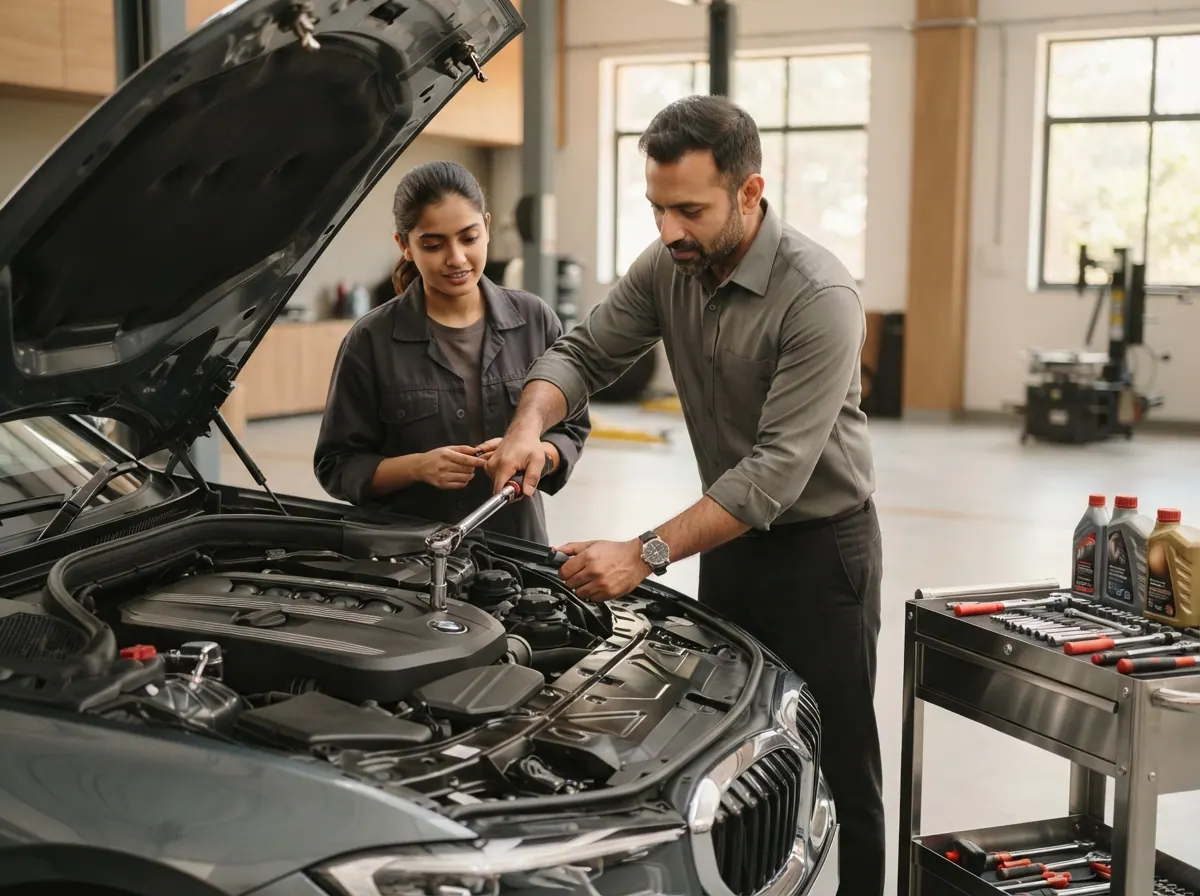
To start a car garage business in India you need a workshop of about 600–1,000 sq ft with a roof and a flat floor, a two-post lift or pit, a compressor and basic tools, a good head mechanic, and about ₹3–15 lakh. The money is in repeat servicing and fair repairs, not in a few big jobs. The customer's trust is your main stock.
All figures here are estimates. Check prices near you before you spend.
What does it cost?
| Item | Small garage (about ₹3–5 lakh) | Bigger garage (about ₹12–15 lakh) |
|---|---|---|
| Rent advance for workshop | ₹60,000–1.2 lakh | ₹1.5–3 lakh |
| Two-post lift or inspection pit | ₹1–1.5 lakh | ₹3–4 lakh for two lifts |
| Air compressor and air tools | ₹40,000–70,000 | ₹80,000–1.2 lakh |
| Hand tools, jacks, stands | ₹40,000–70,000 | ₹1–1.5 lakh |
| OBD scanner and battery tester | ₹10,000–30,000 | ₹40,000–80,000 |
| Wheel alignment and balancing | not at start | ₹3–4 lakh |
| Spare parts, oil and consumables stock | ₹40,000–70,000 | ₹1.5–2.5 lakh |
| Signboard, office, furniture, deposit | ₹20,000–40,000 | ₹50,000–80,000 |
| Total | about ₹3–5 lakh | about ₹12–15 lakh |
Alignment and balancing machines are the biggest single cost. Add them only when you can see customers asking for them every week.
What work should you take?
- Periodic service: oil, filters, brakes, a check of fluids and tyres. This brings people back.
- Brakes, clutch and suspension: usual wear on Indian roads, and where a good mechanic earns their name.
- AC repair and gas refill: busy in summer, but needs the right equipment and skill.
- Electrical and battery work: needs a scanner and a patient hand.
- Denting and painting: a separate set of tools and a spray booth, so add it only if you have space.
How much can it earn?
Take a small garage with a lift, working 26 days a month, handling about 70 cars. The average bill is a guess, so use what your area charges.
Income (what you keep before running costs)
- Labour charges per car: about ₹1,200
- Margin on parts and oil per car: about ₹600
- ₹1,800 × 70 cars = ₹1,26,000
Costs
- Head mechanic: ₹20,000
- Second mechanic: ₹16,000
- Helper: ₹10,000
- Rent: ₹25,000
- Power, water and phone: ₹6,000
- Consumables and tool repair: ₹8,000
- Loan instalment on ₹6 lakh: about ₹14,000
- Total = ₹99,000
Left over: ₹1,26,000 − ₹99,000 = about ₹27,000 a month.
If you do the repair work yourself, you add the mechanic's pay to your own. Warranty or comeback jobs, which you must redo free, eat into this. One bad engine repair can cost more than a week of profits.
What do you need before you start?
- A trusted head mechanic. Most garages succeed or fail on this person. Ask for work they have done and speak to their earlier customers.
- A location near homes or taxi stands. People bring cars to garages they pass daily. A quiet lane means waiting a long time for customers.
- Space for parked cars. Customers leave their cars for days. You need safe room and a lock.
- A parts source. A nearby spare-parts dealer who gives credit and genuine parts.
- Money for a bad month. New garages are slow for the first few months.
Step by step
- Work or spend time in a garage for a few weeks, and note what customers ask and what they complain about.
- Pick the location, then check the rent, power load and whether you can park cars there at night.
- Hire the head mechanic and agree pay and what they will not do (for example, no shortcuts on brakes).
- Buy the lift, compressor and tools in stages. Do not buy everything on day one.
- Open an account with a parts dealer and a lubricant distributor.
- Write an estimate before every job and get the customer's yes before extra work.
- Keep a record of every car: number, work, parts, date and next service.
- Call customers for their next service. A phone call is your cheapest advertising.
Which licences apply?
- Shop or trade licence from your local body.
- GST registration if your turnover needs it. Ask a CA.
- Fire safety. Oil, paint and a compressor are a fire risk. Ask your local fire office what you need.
- Used oil and battery disposal. Do not pour oil into drains. Ask your state pollution control board how to dispose of it.
- Authorised service tie-ups. If you want to claim to be a branded service centre, you need that company's permission.
- Loans. Banks give equipment and working-capital loans, and some schemes support small units. Ask your bank before you assume any scheme applies.
What goes wrong?
- Customers who feel cheated. Replacing parts that did not need replacing is the quickest way to lose a customer for good. Show the old part.
- The mechanic leaves and takes customers. Pay them fairly, and keep a record of every customer in your own book.
- Fake or cheap parts. A poor brake pad that fails once will cost you more than the profit from a year of sales.
- Cars left for weeks. A car whose owner will not pay blocks your space.
- Comebacks. A repair that fails after a week. Be ready to redo it without a fight.
- Slow cash. Taxi owners and companies pay late. Do not give open credit to everyone.
Situations you will face
What would you do? Each choice costs something.
Getting started
A two-post lift costs more but is safer and faster. A pit is cheap to build but slow to work in.
- Buy a two-post lift: Costly, faster jobs
- Build an inspection pit: Cheaper, slower work
One mechanic is fast and asks ₹25,000. Another is careful and asks ₹18,000.
- Hire the fast one: Costly, quick jobs
- Hire the careful one: Cheaper, fewer comebacks
A good scanner reads many car brands. A cheap one reads only a few.
- Buy the better scanner: Costs more, handles more cars
- Buy the cheap one: Saves money, turns cars away
The highway shop gets breakdowns and passers-by. The colony shop gets regular servicing.
- Take the colony shop: Steady service customers
- Take the highway shop: More breakdowns, less loyalty
A big dealer offers 30 days credit on genuine parts, with a high price. A smaller dealer is cheaper but only for cash.
- Take the credit: Easy cash, higher prices
- Pay cash to the cheaper dealer: Lower price, tight cash
A large compressor runs every tool but uses much power. A small one is cheaper and slow.
- Buy the large compressor: Costly, faster work
- Buy the small one: Cheaper, jobs slower
A bright board with phone number brings walk-ins. A plain one costs a third.
- Make a bright board: Cost now, calls later
- Use a plain board: Saves money, fewer calls
First month
Cars are few and the mechanic stands idle.
- Offer a free 20-point check: Costs time, builds trust
- Wait for walk-ins: No cost, slow start
An owner wants a fixed price for a clutch job. Hidden damage could raise it later.
- Give a range and ask yes after opening: Fair, customer may hesitate
- Give a fixed price with margin: Honest, may lose to cheaper quotes
A first-time customer says they want to see every replaced part.
- Keep and show the old parts: Small effort, builds trust
- Show photos of old parts: Small effort, honest record
A tyre company offers a starter lot on credit. Tyres need room and tie up money.
- Stock a small tyre lot: Extra income, money tied up
- Order tyres only when asked: No stock, small margin
Running it
A car you serviced is back with brake noise. The owner is calm but unhappy.
- Redo and check it free: Cost now, good name
- Charge half for the redo: Fair, customer may be unhappy
A fleet owner with six taxis wants regular work and a 20 percent discount.
- Give the discount: Steady work, lower margin
- Offer 10 percent: Higher margin, may refuse
Cars arrive for AC repair. You have gas but no leak tester.
- Buy a leak tester: Cost now, proper repairs
- Test and quote the leak repair: Slower, fewer quick jobs
A supplier offers pads at half the usual price, but without a brand name.
- Buy branded pads only: Lower margin, safe brakes
- Buy cheaper known-brand pads: Moderate margin, fine quality
A taxi owner keeps promising to pay at month end.
- Hold the taxis until paid: Likely paid, lose client
- Keep working, ask a part: Keeps client, risk remains
Your head mechanic says another garage offered ₹6,000 more.
- Match the raise: Keeps the mechanic, lowers profit
- Refuse: Saves money, may leave
A car waits for a rare part for two weeks. The owner calls daily.
- Update daily, offer a loan car: Costs effort, calm owner
- Ask for patience: No cost, anger grows
Used oil barrels are filling the back corner.
- Sell to an authorised collector: Small income, compliant
- Store in sealed drums: Small cost, lower fire risk
When things go wrong
You replaced a sensor for ₹3,500, but the fault was a loose wire. The owner is back.
- Admit it and refund the sensor: Costs now, builds trust
- Refund half the sensor, explain: Costs now, honest answer
The owner says the scratch was not there when the car came in.
- Check your photos and settle fairly: Small cost, calm end
- Deny it: No cost, bad word spreads
A welding spark lands near oily rags. Nothing burns, but it was close.
- Buy extinguishers and clear the area: Cost now, safer shop
- Move rags to a metal bin: Small cost, lower fire risk
A new garage offers service for ₹500 less.
- Match on basic service only: Keep customers, small loss
- Hold your price and quality: Lose some, keep loyal
An owner says the engine seized after your oil change. The sump plug was loose.
- Pay for the engine repair: Heavy cost, honest
- Refuse and dispute: Saves cash, name suffers
Cuts stop the lift and compressor several times a week.
- Buy an inverter or generator: Costly, steady work
- Work around the cuts: No cost, lost hours
Growing
Customers ask for alignment and balancing every week and you send them elsewhere.
- Buy the machine: Big cost, new income
- Tie up with a tyre shop: Low cost, small commission
Cars wait outside because the lift is busy.
- Add a second lift: Costly, doubles capacity
- Extend working hours: No cost, tired team
A company with 15 cars wants one garage for yearly service at a fixed rate.
- Sign the contract: Steady work, late payment
- Decline: Keep flexibility, lose income
Busy owners ask if you can pick up their cars.
- Start pick-up and drop: Costs a driver, more bookings
- Do not offer: No cost, lose busy owners
Owners ask where to get dents fixed. A bay needs a booth and a painter.
- Add a denting bay: Costly, higher bills
- Partner with a body shop: Low cost, small commission
Is it right for you?
A garage suits you if you like machines, can talk straight to customers, and can handle people who work with their hands. It suits you less if you want the money to arrive quickly, or if you cannot spot a bad repair.
A good test: work two months as a helper in a busy garage. See how many cars come, how the owner speaks to unhappy customers, and how many days a car sits waiting for a part. Then decide.