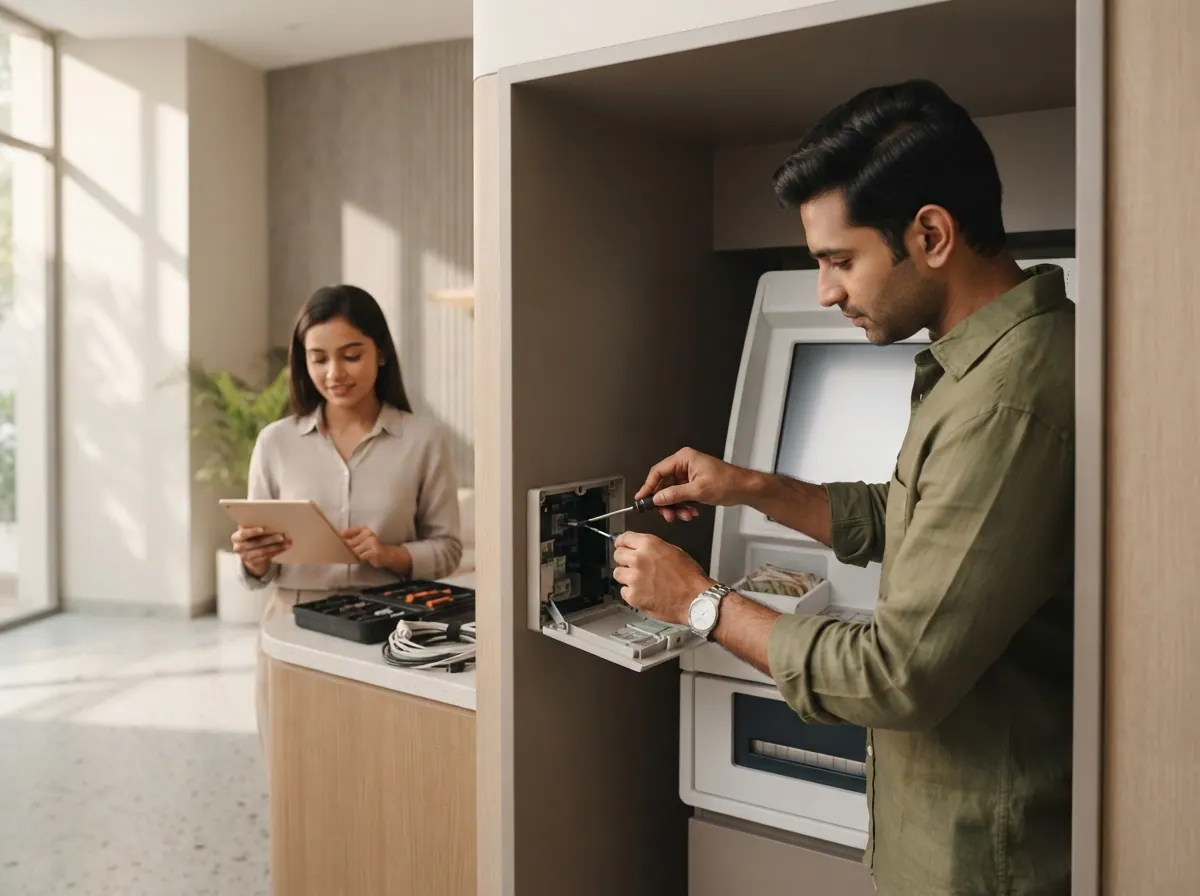
An ATM franchise in India is usually not a franchise at all but an arrangement where you host a machine that a company runs, and you earn a small share of each transaction. Offers speak of about ₹2–8 lakh, mostly as a deposit and working capital, and your income depends only on how many people use the machine each day. It is also one of the most faked business offers in India, so read this before you pay anyone.
All figures here are estimates. Check prices near you before you spend, and confirm every term in writing.
What is an ATM franchise?
ATMs that are not owned by a bank are called white-label ATMs. They are run by a few authorised companies and approved by the banking regulator. These companies look for sites, such as a shop front or a ground-floor room, where they will place machines. If you give them a good site, you become the host, sometimes called the franchisee or site partner.
You do not run the machine's software or fill cash in most such arrangements. The company does that. You provide the space, power, security and a deposit, and you share a part of the fee per transaction. Always ask the company for exactly who does what.
What does it cost?
| Item | Typical range (estimate) |
|---|---|
| Refundable security deposit to the company | about ₹1–3 lakh, if the terms say refundable |
| Space preparation: signboard, wiring, lighting | ₹30,000–1 lakh |
| Power backup (inverter) | ₹15,000–40,000 |
| Air conditioner, if the booth needs one | ₹30,000–50,000 |
| Guard, CCTV and shutter | ₹20,000–70,000 |
| Working capital and first months of costs | ₹50,000–1 lakh |
| Total | about ₹2–8 lakh |
The deposit is the number that matters most, so ask: Is it refundable? When? What can be deducted? A deposit that can be deducted without clear rules is a risk.
How much can it earn?
Take a site where about 150 people withdraw cash each day. The share per transaction is a guess, so use what your agreement says in writing.
Income
- 150 transactions a day × ₹5 share = ₹750 a day
- ₹750 × 30 days = ₹22,500 a month
Costs
- Electricity and cooling: ₹3,500
- Guard (shared or paid): ₹8,000
- Space you could otherwise rent out: ₹5,000
- Total = ₹16,500
Left over: ₹22,500 − ₹16,500 = about ₹6,000 a month.
That is small, and many sites do not reach 150 transactions a day. In a quiet lane, the same machine can bring in half as much and the costs stay. A site near a busy market, a bus stand or a bank branch does better. The real return on a deposit of a few lakh is slow, so be sure about the exit terms.
What do you need before you start?
- A busy site. Close to a market, a bus stand, a hospital or an area without nearby ATMs.
- Space and approvals, as the company asks: a ground-floor room, a separate entry and a safe area.
- A clear written agreement. Reviewed by a CA or a lawyer before you pay.
- The company's real office. Visit it, and see sites that are actually working.
Step by step
- Count the ATM use near you. Note how many ATMs are within 500 metres, and whether they are often out of cash or crowded.
- Find the real companies. Look at the operators' own websites and phone numbers, not at advertisements that promise quick money.
- Ask for the agreement first, with the share per transaction, who pays for what, the deposit terms and how you can leave.
- Visit an existing site and speak to the host about what they really earn.
- Pay only to the company's official account, against a receipt in the company's name.
- Prepare the site as the company asks, and get the work approved before you open.
- Check your statements against the company's reports every month.
Which licences apply?
- The operator's authorisation. The company that runs the ATM must hold the banking regulator's authorisation. Ask to see it. This is not something you get.
- Premises. A shop or room you own or rent, with the landlord's permission if you rent.
- Shop or trade registration if your local body requires it.
- GST if your turnover needs it. Ask a CA how the share you receive is treated.
- Security rules. The company will specify guard, CCTV and shutter requirements.
- Loans. Banks may lend for working capital. Confirm the terms with them.
What goes wrong?
- Fake franchise offers. Fraudsters take a registration fee, a security deposit or a "site inspection fee" and disappear. Real companies do not hide behind a mobile number and a personal bank account.
- Hidden deductions. The deposit is returned late or only in part. Read the exit clause.
- A quiet site. Few transactions mean a very small share, and you still pay power and a guard.
- Cash outs. When the machine is often empty or down, customers stop using it. Know who is responsible for refilling.
- Security risks. ATMs attract thieves. Ask about insurance and who bears a loss.
- Property problems. A landlord who ends your lease, or a society that objects to the booth.
Situations you will face
What would you do? Each choice costs something.
Getting started
A caller says your ATM site is approved if you pay ₹25,000 to a personal account today.
- Refuse and check the company: Safe, lose the quick offer
- Ask for the agreement first, then decide: Takes days, may lose the slot
You can visit the company's city office, a two-day trip, or accept an online meeting.
- Make the trip and see a site: Costs a trip, real answers
- Do it online only: Saves cost, less certainty
Your shop front is on a busy road. Your back-street room is cheaper but quiet.
- Offer the busy front: Better use, lose shop space
- Offer the back room: Cheap, fewer transactions
The draft says the deposit may be adjusted against dues, without saying which dues.
- Ask for exact terms in writing: Slow, safer
- Sign and trust: Faster, risk later
Cuts are common in your lane. An inverter costs money but keeps the machine on.
- Buy an inverter: Cost now, steady use
- Rely on mains power: No cost, lost transactions
The company says an AC helps the machine and customers. It costs ₹40,000.
- Install an AC: Cost, comfort and uptime
- Use a fan: Cheap, hot booth
Your lane is quiet at night. A guard costs ₹8,000 a month.
- Hire a night guard: Cost, safer machine
- Rely on CCTV only: Cheaper, more risk
You rent your shop and the landlord has not agreed to an ATM at the front.
- Get written consent: Takes time, safe
- Offer more rent for consent: Costs rent, consent in writing
First month
The ATM is working, but few people know about it.
- Put up a board and tell shops: Small cost, more users
- Wait for people to notice: No cost, slow
The first monthly statement shows fewer transactions than the machine's counter.
- Ask the company for the full report: Time, fair share
- Accept the statement: No effort, may lose money
Running it
Customers are complaining that the ATM is out of cash.
- Call the company hard: Time, usually fixed fast
- Put up a notice and wait: No effort, lost trade
A man standing near your ATM offers to help old people and watches their PINs.
- Tell the guard and the police: Safe for customers
- Put up a warning notice: Small cost, fewer customers cheated
A customer's card is stuck in the machine and they shout.
- Call the company with them: Time, calm outcome
- Tell them to call their bank: No effort, anger grows
The AC and machine raise your power bill by ₹2,500.
- Switch to energy-saving use: Small cost, lower bill
- Ask the company to share it: Time, may be refused
Late-night customers make noise and park badly.
- Set closing hours and a parking rule: Fewer users, calmer lane
- Ignore the complaint: No cost, tension grows
A bank installs an ATM 100 metres away.
- Improve your visibility and uptime: Costs a bit, holds users
- Do nothing: No cost, usage drops
The machine shows an error. The company says a technician will come in three days.
- Escalate and ask for a time: Time, faster visit
- Wait quietly: No effort, lost trade
When things go wrong
A friend says another ATM firm will give you two machines if you pay ₹3 lakh in advance.
- Check the firm and the licence: Time, avoids a scam
- Pay half to hold the slot: Quick, risk of losing the money
Someone tried to break open the booth at night. Nothing was taken.
- Add a stronger shutter and alarm: Costly, safer
- Just repair the lock: Cheaper, risk remains
You asked to leave, but the company has delayed the refund for two months.
- Send a formal notice: Time, may get it back
- Keep calling: No cost, slow
Your landlord asks for 30 percent more because of the ATM crowd.
- Pay the new rent: Keeps site, less profit
- Negotiate a longer lease: Time, safer future
A customer says their account was debited but no cash came.
- Help them file with the company: Time, trust earned
- Tell them it is not your problem: No effort, bad word spreads
Festival break and a bank strike make transactions low.
- Wait it out: No cost, small income
- Shut the AC and cut hours: Saves cost, fewer users
Growing
A distributor suggests adding mobile recharge and bill payment at the ATM shop.
- Add the services: Small cost, more footfall
- Stay with the ATM: No spend, steady
The company offers a second machine at your second shop, with another deposit.
- Take the second machine: Costly, more income
- Stay with one: Safe, lower income
A bank offers a small commission if your shop becomes a deposit point.
- Take the tie-up: Extra income, more work
- Decline: No work, lose income
A cleaner booth with lighting can increase use at night.
- Upgrade the booth: Cost, more night use
- Leave it as it is: No cost, no change
Your site does 250 transactions a day, well above the average.
- Ask for a higher share: Time, may be refused
- Stay with the current share: No effort, lose possible income
A rival firm offers a better share if you switch after your term ends.
- Honour your term, then switch: Slow, keeps your name
- Break the agreement now: Fast, lose deposit
Nearby bank staff want a weekend camp at your shop.
- Host the camp: Small effort, more footfall
- Decline: No effort, miss footfall
Is it right for you?
Hosting an ATM suits you if you already own or can rent a good, busy frontage, and want a small, steady income without running a shop day-to-day. It suits you less if you hope for a large income from the deposit you pay, or if you cannot confirm the company is genuine.
A good test: before paying anything, visit two working ATM sites of the same company at the busiest hour and the quietest. Ask the host their real monthly share, and compare it with your site.